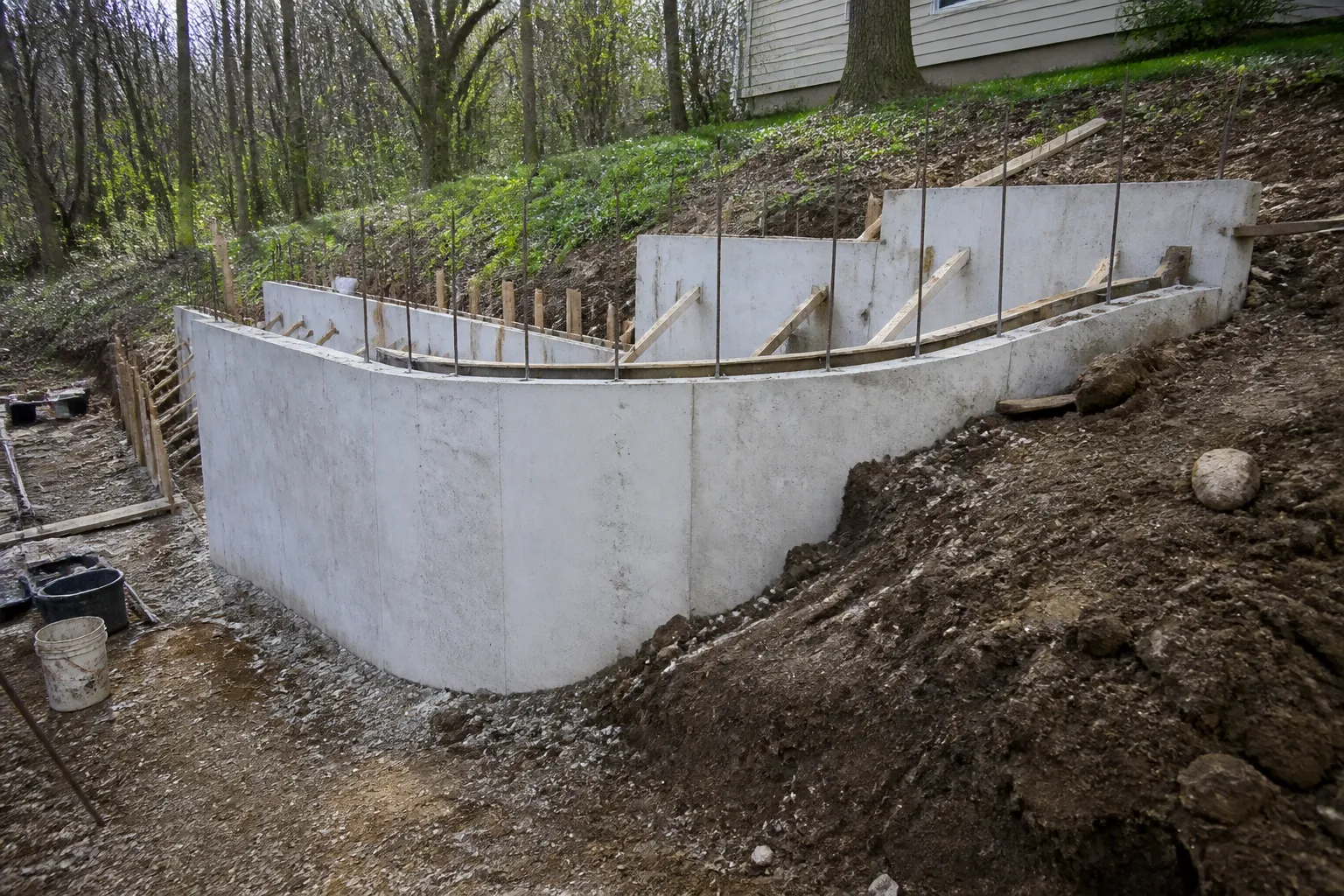
When a slope starts pushing on your yard, a retaining wall stops being a nice upgrade and starts being a real need. Cracked edges, washed-out soil, and sections that lean or spread are all signs the wall is no longer doing its job.
Bloomington Elite Concrete Contractor helps property owners turn unstable slopes into clean, usable spaces with concrete retaining walls built for lasting support. If you need a wall for a yard, driveway edge, garden bed, or commercial property, we can look at the site and recommend a solid next step.
Concrete retaining walls are designed to hold back soil and shape areas where grade changes make landscaping, access, or daily use more difficult. For many Bloomington properties, the need starts small. A section of mulch slides downhill. A patio edge loses support. A low slope begins to creep toward a walk area. Once that movement starts, the wall has to do more than look neat. It has to resist pressure and keep the site organized.
Bloomington Elite Concrete Contractor builds retaining walls for homeowners and businesses that want a durable solution instead of a short-term patch. We focus on the wall’s height, the load behind it, and how the layout should work with the rest of the property.
A failing retaining wall usually gives warning signs before it gives way. Paying attention early can help you avoid larger repairs and a more complicated rebuild. If you are seeing movement, bulging, or water escaping from places it should not, the wall may be under more pressure than it was built to handle.
If you notice any of these conditions, it is worth having the wall looked at before the issue spreads to nearby concrete or landscaping.
Not every retaining wall serves the same purpose. Some are short and decorative. Others need to support a much heavier load and stay stable over a larger span. The right design depends on the site, the height of the grade change, and how the space will be used after the wall is finished.
Low concrete retaining walls are often used for garden borders, raised planting beds, and small grade transitions. Even at a modest height, these walls need careful planning so they stay level and resist settling.
When the wall has to hold more soil or shape a more active part of the property, build quality matters even more. A wall near a driveway, walk, or garage area needs to support the site while keeping the surrounding surface easier to use and maintain.
Commercial properties often need retaining walls that support clear access, better site organization, or cleaner edges around paved areas. We can help plan a layout that works for the property’s use, not just its appearance.
At Bloomington Elite Concrete Contractor, the goal is to make the project straightforward from the first conversation through the finished wall. We start by reviewing the property, understanding what the wall needs to hold, and talking through the result you want to see.
That process keeps the work focused on the actual site conditions rather than a one-size-fits-all approach.
Concrete is a strong choice for retaining walls because it offers durability and a clean, consistent appearance. It also gives property owners a practical wall that can match other concrete features on the site, such as sidewalks, patios, slabs, or garage floors.
Depending on the project, the wall may need a simple, streamlined finish or a more decorative look that blends with the property. Some owners want the wall to stand out as a defined feature. Others want it to stay understated and let the landscape take focus. We can help guide those choices so the wall matches the purpose of the space.
Some walls can be repaired. Others have moved too far or broken down too much to keep relying on them. Choosing between repair and replacement depends on how serious the movement is and whether the wall can still support the soil behind it.
Minor surface damage does not always mean a full rebuild. But when a wall is leaning, separating, or failing across more than one area, a replacement may be the more practical solution. We can help you assess what makes sense for your property so you are not investing in a fix that leaves the same problem behind.
Good retaining wall work starts with a clear plan. The wall has to fit the land, the intended use, and the rest of the property. If it is too short, it may not hold what it needs to hold. If it is oversized or awkwardly placed, it can create new problems with access or appearance.
For Bloomington properties, that planning step is often what separates a wall that looks good for a while from one that keeps doing its job year after year. Bloomington Elite Concrete Contractor takes time to understand how the wall will be used so the finished project feels like part of the property, not an afterthought.
A retaining wall holds back soil and helps manage changes in grade. It can also define outdoor spaces and create a cleaner, more usable layout.
Look for leaning, cracks, gaps between sections, soil washout, or water collecting near the base. Those signs often mean the wall is under stress.
Yes. A retaining wall can make a sloped area easier to use by creating flatter sections for landscaping, access, or other property features.
Concrete offers strength, a clean appearance, and flexibility for both simple and more substantial retaining wall projects.
Yes. A retaining wall can be planned to coordinate with patios, sidewalks, slabs, garage floors, and other site elements.
Yes. We handle retaining wall projects for homeowners and businesses throughout Bloomington and nearby communities.
If your property needs a retaining wall that can handle soil pressure and still look clean, Bloomington Elite Concrete Contractor is ready to help. We work with property owners across Bloomington and nearby service areas, including Mahomet, Washington, Morton, Clinton, Monticello, Eureka, El Paso, Le Roy, Heyworth, Lexington, Downs, and Chenoa.
Call +13095041351 to talk through your project and request a free estimate. Our office is located at 2404 E Empire St, Bloomington, IL 61704, and we are available every day from 8:00 AM to 8:00 PM.
Start Your Project
Tell us what you need built, repaired, or improved, and we will help you choose the right concrete solution for your property in Bloomington or a nearby community.